Books Read in October 2014
My husband & I spent the first two weeks of October 2014 in southern France (ending with 4 days in Paris), celebrating our 25th wedding anniversary. It was a very special trip because we hadn’t traveled often or far before that, and it was perfect. Oddly enough, even though we had ‘rest’ days, I didn’t get much reading in.
1. The Tucci Table by Stanley Tucci (Nonfiction, Cookbook) 
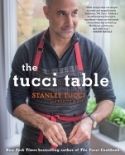 I love Stanley Tucci! Whether he’s a hypersensitive tango dancer in Shall We Dance?, the husband of a beloved cooking icon in Julie and Julia, the mischievous Puck in A Mid-Summer Night’s Dream, or any one of the scores of other roles he’s had, I think he’s brilliant.
So I was bound to love his new cookbook, written with his wife Felicity Blunt (sister of actress Emily Blunt). And I did!
Tucci combines his love of classic French food (which I was enjoying for the first time that month) with the bounty of food available in North America (especially in larger cities) to present a fresh take on the food that has enchanted generations of eaters.
4 stars
2. Dr.Fischer of Geneva or the Bomb Party by Graham Green (Fiction, Vintage, Satire)
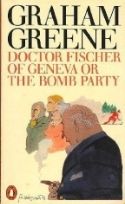
A darkly comic novel about a misanthropic millionaire who decides to hold the last of his famous parties, first published in 1980.
At first, nothing seems to happen. Our narrator arrives as an invited guest to find other diners already at the table. There is a strange current in the air, eventually traced to the strange gifts Dr. Fischer has distributed to his guests.
Clever, as you might expect of Greene.
4 stars
3. Gilead by Marilynne Robinson (Fiction, Literary) 
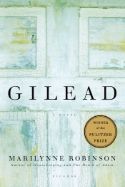
“In Gilead, Iowa, our narrator, John Ames, age 76, a retiring preacher, is writing a letter to his almost seven-year-old son, the blessing of his second marriage. It is a summing-up, an apologia, a consideration of his life. The reason for the letter is Ames’s failing health. He wants to leave an account of himself for this son who will never really know him. Robinson takes the story away from being simply the reminiscences of one man and moves it into the realm of a meditation on fathers and children, particularly sons, on faith, and on the imperfectability of man.”
Although this is wildly popular, I found it so-so. Perhaps my age—or study of the Bible—has me in a place in life where Ames’ wonderings seemed self-conscious and/or prosaic.
3½ stars
4. 10:04 by Ben Lerner (Fiction, Contemporary)
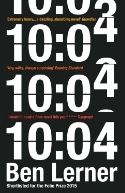 To give this books its due, I will note that it was named “One of the Best Books of the Year” by:
The New Yorker, The New York Times Book Review, The Wall Street Journal, The Village Voice, The Boston Globe, NPR, Vanity Fair, The Guardian (London), The L Magazine, The Times Literary Supplement (London), The Globe and Mail (Toronto), The Huffington Post, Gawker, Flavorwire, San Francisco Chronicle, The Kansas City Star, and The Jewish Daily Forward.
It was also the winner of The Paris Review‘s 2012 Terry Southern Prize and a finalist for the 2014 Folio Prize and the NYPL Young Lions Fiction Award.
It’s another that I found only ‘meh”. Again, I think perhaps I’m too old.
3½ stars
5. Julia, Child by Kyo Maclear, illustrated by Julie Morstad (Fiction, children‘s picture book) 
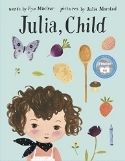 Maclear imagines Julia Child and her co-author of Mastering the Art of French Cooking as children. They observe that adults have forgotten joy and are a grey and dreary bunch. Julia & Simone concoct delightful food that teaches the adults to be better people.
My goodness, I’m getting crotchety in my old age. I don’t think that children should be celebrated, to themselves at any rate, for teaching adults. This book seems to be saying “kids know better.”
Sorry, I don’t think they do.
3 stars
* * * * *
I’m including the only mystery I read this month in this post.
6. Death in High Heels by Christianna Brand (Fiction, Mystery, Vintage)
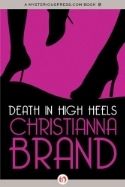
Christianna Brand, who died in 1988, wrote mysteries that were published between 1940 and the early 1980s. Her work thus overlapped with Christie and Marsh and she is considered by some to be their peer.
Death in High Heels (1941) was her first Inspector Charlesworth mystery and one of her earliest works, and it was my introduction to her writing. I had the feeling that Brand hadn’t quite crystallized her characters yet and, as a result, the book felt a little unanchored to me.
I was glad, however, to finally ‘meet’ Brand.
3½ stars
All in all, France was wonderful; the reading, a little less so. Have you read any of these?

P.S. The links are affiliate links so I will receive a small percentage of any purchase you make after clicking through from this blog.
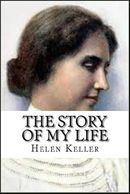 Written when she was 22; includes various letters she sent as a girl and young woman. I was prompted to read by seeing a performance of Miracle Workerat Theatre Aquarius.
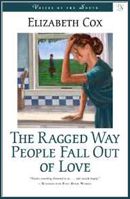 Realistic, but not earth-shattering. I read the last half of the book while I was coming off Effexor [an anti-depressant] and perhaps I was not in a condition to grasp the story. Everything seemed strange.
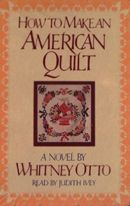 A good, quick read. I thought sometimes that the sections of “instructions” were overdone and too ethereal. But the stories of the people pieced together in this small town were fascinating.
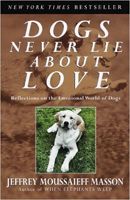 This was really interesting for the first half-dozen chapters, then it seemed to become a lot of padding and unsupported theories. In the end, no one really knows what dogs think or feel – we are limited by being able to think only in human terms. This I knew before I read the book!
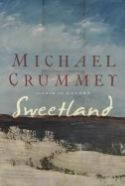 Moses Sweetland, “one crazy coot”, lives on a remote island off the coast of Newfoundland in a community that has been served for decades by a Government-funded supply boat. Now the government wants to cut the boat run so they’ve offered generous packages for the islanders to resettle on the mainland. The catch is, all the residents must agree to the scheme, and Moses doesn’t want to go.
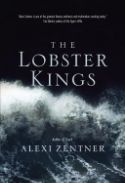 From Amazon: “The Kings family has lived on Loosewood Island, Nova Scotia for three hundred years, blessed with the bounty of the sea. But for the Kings, this blessing comes with a curse: the loss of every first-born son. Now, Woody Kings, the leader of the island’s lobster fishing community and the family patriarch, teeters on the throne, and Cordelia, the oldest of Woody’s three daughters, stands to inherit the crown. To do so, however, she must defend her island against meth dealers from the mainland, while navigating sibling rivalry and the vulnerable nature of her own heart when she falls in love with her sternman. Inspired by Shakespeare’s King Lear, The Lobster Kings is the story of Cordelia’s struggle to maintain her island’s way of life in the face of danger from offshore, and the rich, looming, mythical legacy of her family’s namesake.”
 This is the first book in the Commissaire Laviolette series, first published in French in 1973 but only recently translated into English.

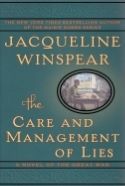 Two women have been friends since childhood. Now adults, one marries the brother of the other and moves to the family farm. War erupts and Tom enlists, and it falls to Kezia to run the farm, without much help because all the other young men are also enlisting.
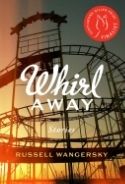
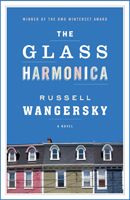 Set in St. John’s Newfoundland where the author lives and works as editor and columnist for The Telegram, The Glass Harmonica is the story of a neighbourhood. In the present, a man witnesses his neighbour shot and killed by a pizza delivery person, but the back story is woven in pieces by various neighbours, back and forth over the course of 40 years. Wangersky has been called a craftsman storyteller. I concur.
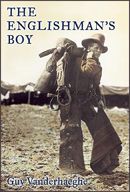 Amazon: “It’s a story within a story–a shimmering romance about the myth of movie-making in Hollywood in the 1920s and an account of a real-life massacre of First Nations people in Montana in the 1870s. Linking these two very different stories is Shorty McAdoo, an aging cowboy, who as a young man acted as a guide for the American and Canadian trappers who perpetrated the massacre, and who is now going to be the subject of a no-holds-barred blockbuster set to rival D.W. Griffith’s epic Birth of a Nation.” (My note: The massacre actually took place in Saskatchewan but was spearheaded by American wolf-hunters from Montana.)
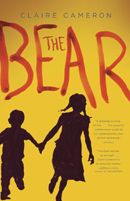 The Bear (the novel) is told through the eyes and voice of five year old Anna, one of those kids. She and her two year old brother Stick are the survivors of an attack that kills their parents.
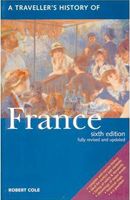 I struggled through this for the sake of our planned trip to France, starting in June and not finishing it until nearly the end of July.
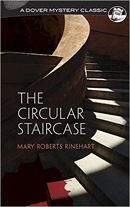 Mary Roberts Rinehart was considered the American Agatha Christie and for many years reigned as queen of the American mystery genre. The Circular Staircase was her second published book (1908) and featured the second, and last, outing of the tart-tongued middle-aged Miss Cornelia Van Gorder. Miss Van Gorder has invited her niece and nephew to accompany her to a country house for a relaxing summer. But instead of rural quiet they found murder and hijinks.
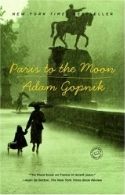 This book is a collection of his award-winning “Paris Journals” that he filed for the magazine. But unlike other books that are an assemblage of essays, this book is not choppy or undisciplined. It’s an intelligent, heartfelt look at the most beautiful city in the world at the turn of the twenty-first century. (Gopnik was there for Y2K but returned to America shortly thereafter.)
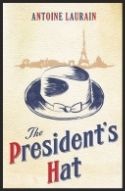 What could be more French than a book that was popular with the reading public there and concerns the hat of the President of France?
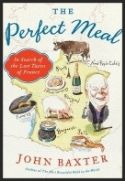 Thus he tracks down and eats bouillabaisse, foie gras and truffles and many other delights. I learned the right way to eat a croissant (it’s “not eaten dry—it is dipped in coffee”), what fleur de sel is (“dust-fine ‘flower of the salt’ skimmed from the topmost layer of the pans where seawater is evaporated”) and when to drink café crème (“one never drinks café crème after midday any more than we eat cornflakes”) among a host of fascinating tidbits. (He also mentions how “sweet, cold white wine such as
 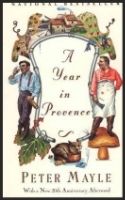 First published in 1989, this account of Englishman Mayle’s life in the countryside of Provence is a modern classic.
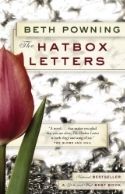 Because Powning is “almost local” I read this when it was first published in 2004. I was disappointed on that first reading, expecting the letters of the title (letters her grandparents wrote to each other in the nineteenth century) to play a bigger part.
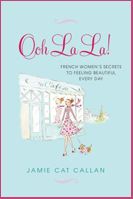 Callan spent time in France interviewing and visiting French women in their milieu to try to crack the code to their famous French sensuality.
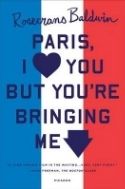 In the mid-aughts of this century, Rosecrans Baldwin and his wife moved to Paris when he as offered a job at a Parisian ad agency―even though he had no experience in advertising, and even though he hardly spoke French. In this book, he draws a picture of their 18 months living in the French capital.
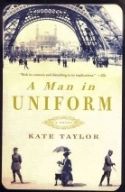 Some of you may be familiar with the infamous Dreyfus affair but before this month in 2014, I would have sworn I had never heard of it. Of course, since then, I’ve seen countless casual references to it so it was probably around me all the time.
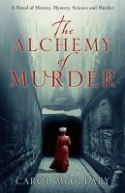 This is the first in McCleary’s series featuring the real-life reporter Nellie Bly, who was famous in the early part of 20th century for her expose of conditions in Bellevue Asylum for the Insane in NYC, and for her round-the-world trip, a la Jules Verne, made in 72 days.
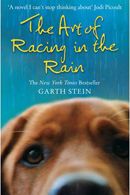 There are two books that I read in May 2014 that I rated 4½ stars at the time, but that have stayed with me so that now, at this review, I have raised the ratings to a full five stars. The Art of Racing the Rain is one of those books.
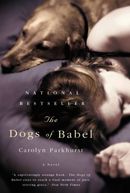 This is the second book on which I’m raising the 4½ stars to a full five. This book continues to haunt me.
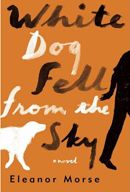 In mid-1970s apartheid S. Africa, medical student Isaac Muthethe has himself smuggled out of the country into Botswana. He is in danger in his home country because he witnessed the murder of a friend by white members of the South African Defense Force. He is hired as a gardener by a young American woman, Alice Mendelssohn, who has followed her husband to Africa. The white dog of the title is a stray that shows up just when Isaac is dropped off in Botswana, and that attaches itself to the young man.
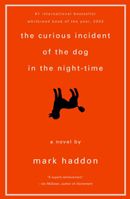 Amazon says: “Narrated by a fifteen-year-old autistic savant obsessed with Sherlock Holmes, this dazzling novel weaves together an old-fashioned mystery, a contemporary coming-of-age story, and a fascinating excursion into a mind incapable of processing emotions.”
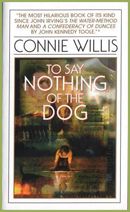 time-traveling tale, or a highly comic romp, or a great, allusive literary game, complete with spry references to Dorothy L. Sayers, Wilkie Collins, and Arthur Conan Doyle? Its title is the subtitle of Jerome K. Jerome’s singular, and hilarious,
 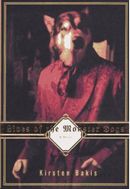 Amazon: “Created by a German mad scientist in the 19th century, the monster dogs possess human intelligence, speak human language, have prosthetic humanlike hands and walk upright on hind legs. The dogs’ descendants arrive in New York City in the year 2008, still acting like Victorian-era aristocrats.”
 Cyrus Mills inherits his father’s veterinary practice and returns to his hometown with the intention of selling the business and leaving again. Of course, his patients change his mind.
 Which should have been wonderful, since I really love railroads. But this book is a debut centering on the Great Flood of 1927 along the Mississippi, a tragedy that killed 246 people and left countless families homeless. The flood led to the great migration of African American families toward other states, and Bill Cheng’s first novel hones in on one fictional family whose experiences seem to represent an endless cycle of grief and loss.
 Finally got around to reading this ‘classic’. Plath’s description of Esther’s descent into depression was so accurate a mirror of my own feelings, it was at once frightening and comforting. How far I could have fallen!
 Recommended by my daughter. My first Urquhart. Set between Ireland and Canada in the mid-1800s. Thought-provoking and enjoyable. Made me want more specific history.
 [2016 notes: Amazon says “Here’s the story of how Truckbox Al McClintock, a small-town greaser whose claim to fame was hitting a baseball clean across the Pembina River, almost got a tryout with the genuine St. Louis Cardinals — but instead ended up batting against Bob Feller of Cleveland Indian Fame in Renfrew Park, Edmonton, Alberta.”
 The three best known and lauded books by author Josephine Tey appear to be Daughter of Time, The Franchise Affair (both in the Alan Grant series), and Brat Farrar. The last of these, a stand-alone novel, was my favourite book in April 2014.
 Harvest focuses on the inhabitants of a remote English village at an undetermined time in what is likely the past.
 The work of D.E. Stevenson was recommended to me by our head librarian on one of my brief visits to our beautiful relatively new village library. We found on the shelf Vittoria Cottage, published in 1949 and the first of a trilogy.
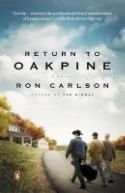 This is the story of four middle-aged friends who once played in a band while growing up together in small-town Wyoming. Two eventually moved away and two stayed in Oakpine. But when the friend who became a famous musician comes back home to die, the friends get together to play again.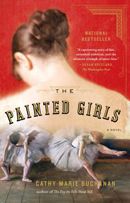
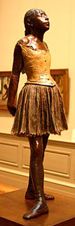
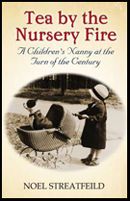
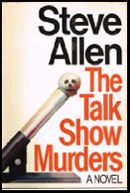 I remember seeing Steve Allen on game shows in the 1970 and liking him, even as a teenager. He seemed to be to be a ‘gentleman’ and he seemed madly in love with his wife Jayne Meadows.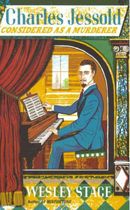

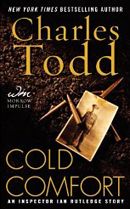 An Inspector Ian Rutledge e-novella set in France in 1915. I suppose the Todds are thinking of mysteries for their character that are set during the war rather than after it, and the only way to write it is in flashbacks.
  planters, bee notepads: anything you can name that could possibly have a bee on it, she had. After a few close friends took the bees they wanted (generally the ones that they had given her), I filled five cardboard boxes with bee paraphernalia.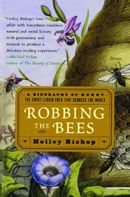
 “Award-winning journalist Hannah Nordhaus tells the remarkable story of John Miller, one of America’s foremost migratory beekeepers, and the myriad and mysterious epidemics threatening American honeybee populations.”
 3.
3.  First published in German in 1912, this series of adventures stars a young rebel bee who leaves the hive despite warnings to the contrary. She encounters good insects and bad, dangers and delights. The overarching theme of the book is a hit-you-over-the-head moral play: obey, work hard, be loyal.
  Although this is #5 in the Detective Joe Sandilands series, it is the first of the series that I have read. Writing about it now reminds me that I wanted to start at the beginning of the series but haven’t yet done so.
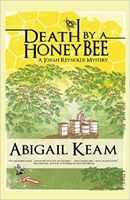 Kobo synopsis: “Josiah Reynolds, a former art history professor, was once a celebrity with wealth, social position, and a famous husband. Now all of that is gone. The professor finds her circumstances drastically altered. Retired, Josiah is now a full time beekeeper trying to stay financially afloat by selling honey at the local Farmers Market.”
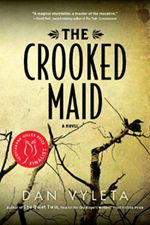 From Amazon: ” Mid-summer, 1948. The war is over, and as the initial phase of de-Nazification winds down, the citizens of Vienna struggle to rebuild their lives amidst the rubble. . . .
  Aka, Nobody Wore Black.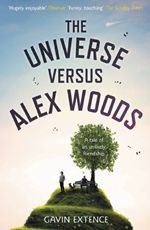
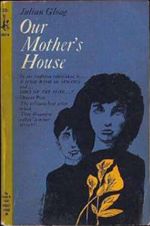 I read this book this month because, well, I was living in my mother’s house after her death.
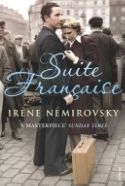 This is the first two parts of what the author evidently intended to be a five part opus. Némirovsky was arrested in 1942 and deported to Auschwitz, where she died. This manuscript, then, was written in the early years of the war in Occupied France, in which she set the novel.
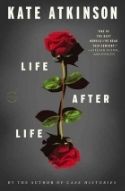 Wow – how to classify this book? By now, you’ve either read the book or heard the premise: Ursula dies at birth, is reborn and this time does not die; Ursula drowns at age 4, we try again and she doesn’t drown; and so on. (So many ways to die!)
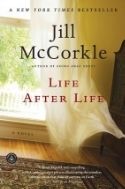 Published in 2013, within two weeks of Atkinson’s book of the same title, McCorkle’s novel seemed to have gotten buried.
 This book showed up in my library inbox in late November because I was trying to complete an unofficial A to Z Reading Challenge using authors’ last names.
 Well, actually, this story is set on Grand Manaan Island which is really Canadian, but the holiday community, at least for the summer discussed, is composed of Americans.
 Blinded in childhood, two young sisters are separated for treatment and lose contact with each other. As an adult, Aileen decides to search out her sister in the Yukon Territory, Canada.
 It’s an interesting aside that Rita Martin was invented in 1938 as a corporate character for Robin Hood flour. According to
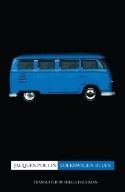 I’ve wanted to read this since Rock Carrier championed it in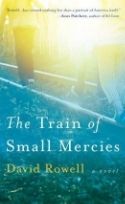
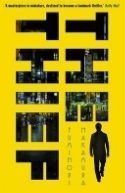


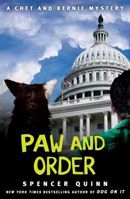
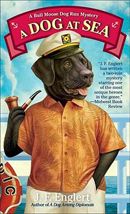
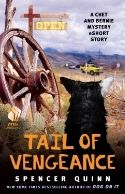
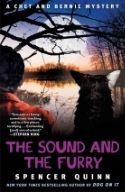 This is the sixth installment in the Chet & Bernie series, which the canine “Chet the Jet” narrates. He and his “partner” Bernie run the Little Detective Agency and have been hired to seek the missing brother of a past “client”. Said brother has disappeared with his houseboat somewhere in the Louisiana bayou. This poses a BIG change of scenery for our boys but Quinn had me smelling those swamps, so succinct were his descriptions.
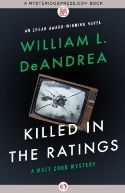 I found reference to this series in Old-Time Detection, a thrice-yearly publication written and published by Arthur Vidro of Claremont NH, and I was able to purchase the Kindle version of the series’ first book.
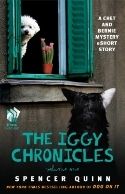 Another sort of prequel to the Chet & Bernie series (see item #1), this is the story of Iggy, the dog next door. Iggy is Chet’s bud, but they don’t see much of each other.
 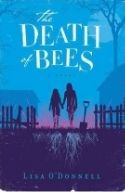 Two young girls bury their parents in the back yard and try to carry on as normal so that their parents’ assistance cheques will keep coming. The lonely widowed next-door neighbour watches them, suspects that something is amiss, and reaches out to include them in his life.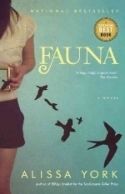
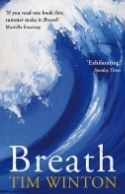 is set in a small fictional village in Western Australia. Childhood friends Piker and Loon grow up daring each to more and more dangerous stunts. As teenagers, they take up surfing and meet Sando, a former pro surfer who leads them to new levels of daring.
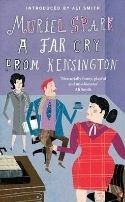 of this book lived in a boarding house in Kensington in the 1950s and recounts the mild adventures of her fellow boarders. As usual, the narrator is a key, but that fact is obscured until the end. This makes it sound as if I didn’t like this book, but I did – a great deal. Spark is a smooth delight at any time.
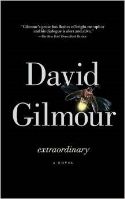 Long-listed for Canada’s prestigious Giller Prize for Fiction, Extraordinary became a controversial choice after comments made by the author that many saw as sexist. It was a challenge to approach this book then, without preconceived ideas about its value.
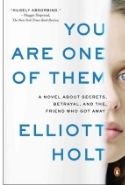 Set during the Cold War, this story revolves around a community of young Americans living and working in Moscow.
 The real
 From Amazon: “After a car crash leaves their friend Marcus dead and his wife Sarah in a coma, Ana and James are shocked to discover that they have become the legal guardians of a 2½-year-old, Finn”.
 by Ernest Buckler (Literary Fiction, Vintage, Canadian author, Atlantic Canadian)
 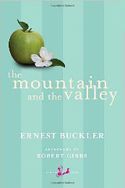 It’s the story of three generations of the Canaan family, particularly David Canaan of the last generation, and illustrates the eternal struggle between generations and the subsequent breakdown of families.
 by Marina Endicott (Fiction, Contemporary, Canadian)
  Open Arms, a finalist for the 2003
  But I wasn’t aware that Regeneration is based on real-life decorated British officer, poet, and pacifist
  One of Pym’s favourite subjects is the behaviour of anthropologists as they study the behaviour of others. In Crampton Hodnet, she again examines this through a young anthropologist who has moved into her mother’s village home in North Oxford to complete a paper. She cannot help observing the inhabitants of the community. This, of course, serves as an outlet for Pym’s observations of human nature. This story is a little more “tied-up” than some of her others and was first published posthumously in 1987.
 When a full-page photo of his